By Robo Digitalis · Side Quest Studios (building a metaverse for Sacred Clowns)
⚡ TLDR (30 seconds):
Tezos is a blockchain (think of it as a shared Google Doc that nobody can delete or fake — it lives on thousands of computers at once) with tiny fees where you can create digital items (wearables) for games and virtual worlds. We're building a whole metaverse on it — publicly, step by step. This article is our real blueprint: mint your first wearable, build the world around it, and launch a marketplace that beats the big players. No gatekeepers. Costs pennies. Starts now.
The next wave of the internet isn’t owned by one company — it’s built by people who ship. Tezos gives you low fees, one token standard (FA2), and a chain that’s ready for an open, usable metaverse. This post is the real blueprint we’re using for Sacred Clowns’ metaverse: minting wearables, in-game economies, and a marketplace that can go toe-to-toe with the big names. Same checklist, same stack, in public. By the end, you’ll know how to mint the item, build the world, and sell the gear.
Who This Is For
- You want to mint your first wearable fast
- You want to build a real metaverse stack, not just collect NFTs
- You want a cheaper alternative to Ethereum for in-game items
- You want a marketplace with in-game buying and trading, not just static listings
If one of those sounds like you, this guide is for you.
Watch First: Get Inspired
Before you dive into the how-to, these will give you a feel for where AR and metaverse are heading — and what’s already live on Tezos.
- The State & Future of AR Games: Rose-Colored Glasses — where AR games are heading.
- Metaverse in your pocket? — how mobile-first metaverse tech works.
- New Tezos NFT Play2Earn Game SWAG WARNING — Tezos-native P2E and wearables in practice.
- Decentralized Applications Architecture — wallet, frontend, and dApp patterns.
- Decentraland: How to submit a wearable collection — what the big players do (and where they fall short).
- Decentraland (MANA) Market Structure Update — market dynamics for comparison.
Research thread
How to mint wearables from Tezos (Perplexity) — minting how-to, XTZ valuation, price history, and builder economics below are sourced from this search.
Hot off the chain (March 2026): Square Enix (Final Fantasy publisher) just became an official Tezos validator baker (a baker is like a referee on the Tezos network — they check that transactions are legit and keep the chain running. Square Enix is now one) — March 12, 2026. The Tallinn upgrade (January 26, 2026) slashed block time to 6 seconds and cut app storage costs up to 100×. US-regulated XTZ futures launched on Bitnomial (February 2026). Tezos gaming hit 440,000 unique users and 31M transactions in 2025. You're building at exactly the right moment.
Sources: Tallinn upgrade, Square Enix baker, Bitnomial futures.
Why Would Anyone Do This? (The Bull Case for Tezos in 2026)
If you're looking at the charts, you might see a "dead" chain. If you're looking at the code, you see a sleeping giant. Here is why we chose to build the Sacred Clowns metaverse here, and why you should too:
1. The "Asymmetric Bet"
Building on Tezos right now is like buying land in Soho in the 70s. XTZ is trading at a ~96% discount from its peak, yet the tech is faster and cheaper than it was at $9.00.
- The Math: You can deploy a production-grade metaverse economy for under $5.00. On Ethereum, that same "I'm just testing this" moment could cost you $500.
- The Play: When the cycle turns, the infrastructure you built today at "bear market" prices becomes a high-value asset.
2. The "AAA" Signal (Square Enix & Beyond)
On March 12, 2026, Square Enix — the giants behind Final Fantasy — stopped just "looking" at Tezos and became a validator. When the world's biggest RPG publisher starts securing the network, the "is this chain for real?" question is officially answered. You aren't building in a ghost town; you're building in the staging area for the next generation of gaming.
3. The "Anti-Gatekeeper" Philosophy
Decentraland and Sandbox have become digital versions of the DMV — long waits, high fees, and committees that decide if your "hat" is worthy.
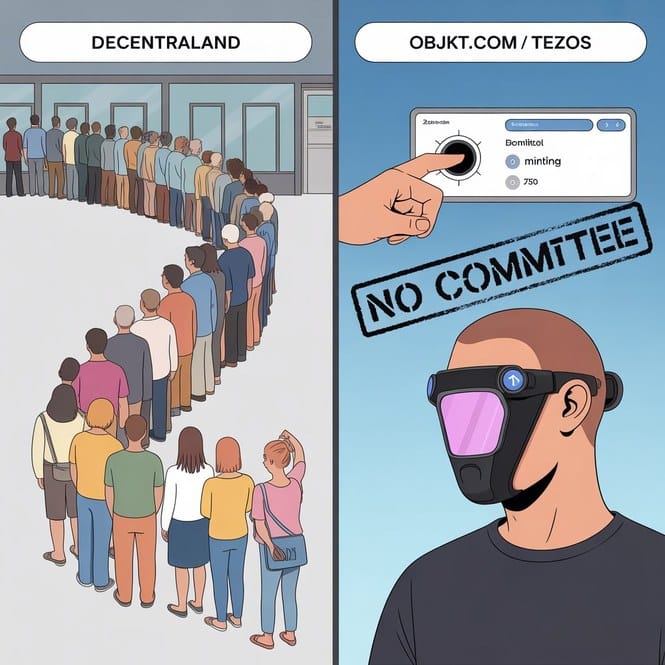
- Tezos is Permissionless: You mint, you list, you trade. No committee. No $5,000 "land" requirements just to host a shop.
- Atomic Swaps: With our Escrow Contract, you can trade a sword for a shield + 10 XTZ directly in the game window. No external marketplaces, no "trust me" DMs. Just pure, trustless trade.
What to notice: Each row is a reason Tezos fits metaverse builders.
| Factor | Why it matters (in plain English) |
|---|---|
| Low fees | You can buy and sell small things in-world without fees eating your profit. |
| Proof-of-Stake | The network uses way less energy than old-school chains — good for the planet and for brands that care about that. |
| Self-amending | The chain can upgrade without big messy “forks” — so it stays stable over time. |
| FA2 (one standard) | One set of rules for NFTs (a digital item with a certificate of ownership baked in — like a serial number on a trading card, but on the internet), tokens, and multi-item contracts. FA2 is Tezos' "one-size-fits-all" rulebook for digital items — like USB-C, one port and everything plugs in. Wearables, in-game money, and land can all live in the same kind of contract. |
Takeaway: Tezos gives you one standard, low fees, and stability — the basics you need to ship a real economy.
In one line: Tezos is cheap enough to experiment on and strong enough to build a real game economy on.
The numbers: XTZ price history — 96% off peak
Tezos today trades around $0.39 — roughly 96% below its all-time high of $9.18 (October 2021). That’s not a random dip: XTZ is trading near its 2018 bear-market floor after a tough 2025. For builders choosing a chain, that combo — deep undervaluation plus strong fundamentals — doesn’t come around often. The last time XTZ was this cheap relative to ATH (All-Time High — the highest price the coin ever hit; XTZ's ATH was $9.18 in October 2021) was the 2018 cycle bottom; that was followed by a 200%+ recovery in 2019. So what? You're building on a chain that's historically cheap to use, right before it's historically likely to get more expensive. coinlore
XTZ price history at a glance:
Use this table to see how far current price is from the 2021 peak — and where past bottoms led.
| Year | Year-end close | % below ATH ($9.18) | Context |
|---|---|---|---|
| 2017 | $4.08 | 56% | ICO launch |
| 2018 | $0.45 | 95% | Crypto winter bottom |
| 2019 | $1.35 | 85% | Recovery |
| 2020 | $2.01 | 78% | DeFi season |
| 2021 | $4.35 | 53% | Bull peak, ATH $9.18 |
| 2022 | $0.72 | 92% | Luna/FTX crash |
| 2023 | $1.01 | 89% | Slow recovery |
| 2024 | $1.29 | 86% | Modest rally |
| 2025 | $0.50 | 95% | Bear grind |
| 2026 (now) | ~$0.39 | ~96% | Near all-time low |
Takeaway: The only time XTZ was this cheap vs. ATH was 2018 — and that was followed by a 200%+ recovery. Building now puts you in that kind of window.
Note: XTZ briefly spiked to ~$1.80 following the Bitnomial futures announcement (Feb 2026) before retracing. Current price ~$0.39 reflects post-spike consolidation — still a historically deep discount. coinlore Yahoo Finance
Building Right Now Is Like Getting a Roblox Developer Badge Before Roblox Was Cool
When you build a metaverse or wearable marketplace on Tezos now, the economics are hard to match:
- Smart contract deployment: (a smart contract is a set of rules that runs automatically on the blockchain — no lawyers, no middlemen, just code) ~0.3–0.5 XTZ ≈ ~$0.15–$0.20 at current prices apriorit
- NFT minting: ~0.05 XTZ ≈ under $0.02 per mint
- Staking: (staking = locking up your XTZ to help run the network. APY = the yearly % you earn back — like interest on a savings account, but crypto.) With the Quebec upgrade's direct staking mechanism, delegators can now stake directly with the protocol — not just delegate to a baker — with rewards increased roughly 3× vs. pre-Quebec. That makes your treasury XTZ work harder while you build. p2p.org
- If XTZ returns to 2024 levels (~$1.29), the XTZ you’ve spent on infrastructure is worth about 3× in USD
Compare that to Ethereum, where deploying a wearables contract can cost $50–$300 in gas (gas = the fee you pay to have your transaction processed. On Ethereum it can be $50+. On Tezos it's fractions of a cent) at any point in the cycle.
Fundamentals that justify the bet
- Self-amending protocol — Tezos upgrades on-chain via governance; no hard forks, no chain splits. Contracts you write today stay compatible with future upgrades. apriorit
- FA2 (TZIP-12) — One standard for fungible tokens, NFTs, semi-fungibles, and non-transferable tokens. Your whole metaverse economy — land, wearables, currency, badges — lives under one interface. opentezos
- Eco-friendly narrative — Tezos uses ~17 mW to mint an NFT vs. 100+ kW on PoW chains. Fashion and sustainability-focused brands (Gap, McLaren, Ubisoft) have chosen Tezos for this. tezos
- Active NFT ecosystem — objkt.com is one of the most active NFT marketplaces by transaction count. Tezos NFT volume was $26M+ in 2023 and $46M+ in 2024 — a real collector base your marketplace can tap into. coinlore
- 2026 catalysts (already live):
- Tallinn (Jan 2026) — 6-second blocks, 100× storage cost reduction, all-bakers attestation chainwire
- Square Enix baker (Mar 12, 2026) — global gaming giant now validating Tezos; signals AAA studio interest in building on-chain cryptonews
- US-regulated XTZ futures on Bitnomial (Feb 2026) — institutional legitimacy unlocked Yahoo Finance
- Tezos X roadmap (H1 2026) — JavaScript + Python smart contract support incoming; opens Tezos to millions more devs
- Bullish analyst target for 2026: $2.46 (MEXC upgraded forecast, Jan 2026) — roughly 6× from current ~$0.39 mexc
The People Who Built in 2018 Were the Millionaires of 2021
The asymmetric opportunity isn’t only holding XTZ — it’s building your marketplace when gas fees, contract costs, and competitor attention are all at cycle lows. When the next bull cycle pushes XTZ back toward $1–$3:
- Treasury XTZ multiplies in USD value
- Royalty income (in XTZ) grows in dollar terms
- Marketplace volume explodes as new users onboard
- Your early position in a Tezos metaverse wearable stack becomes defensible
The builders who shipped on Tezos at the 2018 bottom were the ones selling wearables and art for thousands in 2021. The window to be that builder in the next cycle is right now.
Want the practical version? See Part 1 and Phase 6.
In one line: You’re building on a chain that’s historically cheap right before it’s historically likely to get more expensive.
Part 1 — Minting Wearables: Your First Step Into the Metaverse
🧠 After this section you'll know: what minting actually is, how to label your wearable so games can read it, and how to put it on the blockchain — with or without writing code.
Minting is just “creating a digital thing and putting it on-chain so it’s really yours.” A helmet, a jacket, a sword — once it’s minted, you can use it in games, sell it, or trade it. On Tezos we use FA2: one standard, one contract shape, and a path that scales from your first drop to a full economy.
What FA2 wearables can do
- One-of-one or limited editions — like a rare skin only 100 people have.
- One contract, whole wardrobe — one smart contract can hold your hat, shoes, and jacket.
- Operators — the game or marketplace can move your item (e.g. when you sell it) without you having to click “approve” every time.
- Soulbound-style — we can make items that can’t be traded (e.g. achievement badges).
How we write the smart contract
We have two main choices:
- SmartPy — reads a bit like Python; easiest to get started; has a built-in FA2 library.
- LIGO (JsLIGO / CameLIGO) — more low-level, great for production; we use LIGO with Taqueria.
Example storage shape for an FA2 wearable contract:
collection_storage:
  metadata       : big_map(string, bytes)   # TZIP-16
  ledger         : big_map(token_id, address)
  operators      : operator_storage
  token_metadata : big_map(token_id, token_info)  # TZIP-21
Mint flow (fits narrow viewports):
Mint flow: Creator → pin 3D GLB + JSON metadata to IPFS (ipfs://) → call mint on FA2 contract → ledger records token_id → owner and token_metadata → grant the marketplace contract operator rights to transfer tokens on behalf of users.
Official Tezos docs have a full “Create NFTs from a web application” tutorial using Taqueria (Docker) and Taquito (JS): deployment, IPFS metadata, and a frontend minting UI.
Wearable metadata (TZIP-21) — what we put in the “label”
Each wearable needs a small file (JSON) that describes it. We put that file on IPFS (a decentralized version of Google Drive — your files live on many computers, not just one server that can go offline) and point the contract to it. The file should include:
- name, description, symbol — so people know what the item is.
- artifactUri — link to the 3D model (GLB/GLTF) for in-game use.
- displayUri — a 2D preview image.
- thumbnailUri — small image for marketplaces.
- attributes — e.g. slot (head/body/feet), rarity, stats.
- royalties — what % we get when someone resells (e.g. 5% or 10%).
We upload the JSON and the 3D/image files to IPFS (Pinata or nft.storage work great), then reference the ipfs:// link in the contract.
Minting without writing a contract (no-code path)
If we want to ship fast and skip coding a contract, we can use a platform. What to notice: which platform fits your use case (general, generative, or brand collab).
| Platform | Best for | Notes |
|---|---|---|
| objkt.com | General wearables, collections | Biggest Tezos marketplace; we can still use our own contract later |
| fx(hash) | Generative wearables (random traits per mint) | Code-based; each mint is a bit different |
| Teia | Open, community vibe | Artist-focused |
| Gap Threads / Dogami | Brand collabs | Same FA2 standard |
Takeaway: objkt.com is the biggest Tezos marketplace; for full game logic you’ll still want a custom contract later.
For a full metaverse where wearables can be equipped and a game can move them for us, we rely on a custom FA2 contract so we control operators, equip logic, and royalties.
Want the architecture? See Part 2.
In one line: Minting is just turning your 3D item into something the blockchain can recognize and your game can use.
The 7-step quest
- Set up your tools
- Make the wearable files
- Write the contract
- Deploy to testnet
- Build the mint page
- Launch fast with no-code
- Verify everything works
Think of this like a boss fight: each phase unlocks the next.
🗺️ The Developer's Map
- Phase 1–2: The Setup — Blender & Temple Wallet
- Phase 3–4: The Logic — Smart Contracts & Ghostnet
- Phase 5–7: The Launch — Frontend & objkt.com
How to Mint Wearables on Tezos — Complete Actionable Checklist
This is the full step-by-step checklist we use — the same one we’re working through in public — and you can use it too. Work through it phase by phase: setup, prepare assets, write the contract, deploy, build the minting site, or take the no-code shortcut and go live fast. No gatekeepers, no committee. Just follow the steps and ship.
💡 Stuck? Start here.
If this is your first time with blockchain stuff: do Phase 6 first (the no-code option on objkt.com). Mint one thing, see it live on the internet with your wallet attached to it. That feeling — "I made that and it's on-chain" — is worth more than reading any tutorial. Then come back and do Phases 1–5.
🧱 Why this phase: Before you can make anything, you need your toolbox — this sets up the tools you'll use for every step that follows.
Phase 1: Setup & Prerequisites
- [ ] Install Node.js + NPM — check with
node --versionandnpm --version. Tezos docs - [ ] Install Docker (needed for Taqueria’s LIGO image).
- [ ] Install Taqueria CLI — the official Tezos project tool. Tezos docs
- [ ] Install Temple Wallet (your crypto wallet is like a password manager + bank account in one — it proves you own your stuff and lets you sign transactions) in the browser at templewallet.com. See Imagery guide
- [ ] Fund the wallet with XTZ — buy on Coinbase or Kraken, then send to our Temple address. See Imagery
- For testing: use the Ghostnet faucet at faucet.ghostnet.teztnets.com for free test XTZ.
- [ ] Create a Pinata account at pinata.cloud — create an API key with
pinFileToIPFSpermission. Tezos docs
🎨 Why this phase: Your wearable needs to exist as a file before it can exist on the blockchain — this is where you design, export, and label it.
Phase 2: Prepare Our 3D Wearable Assets
- [ ] Model the wearable in Blender (or similar) — export as GLB/GLTF for 3D use in the metaverse.
- [ ] Export a 2D PNG preview (displayUri) — at least 1000×1000px.
- [ ] Export a thumbnail PNG (thumbnailUri) — 350×350px for listings.
- [ ] Prepare the metadata JSON (TZIP-21 style):
{
  "name": "Dragon Helmet #001",
  "description": "Legendary headgear from the Fire Realm",
  "symbol": "DRGNHMT",
  "artifactUri": "ipfs://<your-glb-hash>",
  "displayUri": "ipfs://<your-preview-hash>",
  "thumbnailUri": "ipfs://<your-thumb-hash>",
  "attributes": [
    { "name": "slot", "value": "head" },
    { "name": "rarity", "value": "legendary" },
    { "name": "defense", "value": "42" }
  ],
  "royalties": {
    "decimals": 4,
    "shares": { "tz1YourAddress": 750 }
  }
}
- [ ] Upload GLB, preview PNG, and thumbnail to IPFS via Pinata — note each
ipfs://hash. Tezos docs - [ ] Upload the metadata JSON to IPFS via Pinata — note the final metadata
ipfs://hash.
⚙️ Why this phase: The smart contract is the rulebook for your wearable — it says who owns it, who can move it, and what it costs. You write it once and it runs forever.
Phase 3: Write the FA2 Wearable Smart Contract
- [ ] Init Taqueria and install deps: Tezos docs
taq init wearables-project
cd wearables-project
taq install @taqueria/plugin-ligo
taq install @taqueria/plugin-taquito
echo '{ "name": "app", "dependencies": { "@ligo/fa": "^1.4.2" } }' >> ligo.json
TAQ_LIGO_IMAGE=ligolang/ligo:1.10.0 taq ligo --command "install @ligo/fa"
- [ ] Create the contract:
taq create contract wearable.jsligo - [ ] Import the FA2 NFT template: Tezos docs
#import "@ligo/fa/lib/fa2/nft/extendable_nft.impl.jsligo" "FA2Impl"
- [ ] Define storage: administrators (who can mint), ledger (who owns what), token_metadata (per-token TZIP-21), operators (who can move tokens), metadata (contract-level TZIP-16). Tezos docs
- [ ] Implement the three FA2 entrypoints: transfer, balance_of, update_operators.
- [ ] Add a mint entrypoint with: token_id, name, description, symbol, artifactUri (IPFS hash for GLB), displayUri, thumbnailUri, attributes.
- [ ] In mint, check admin:
if (!Set.mem(Tezos.get_sender(), s.extension.administrators)) return failwith("NOT_ADMIN"). - [ ] Set initial storage in
wearable.storageList.jsligo— add our wallet to administrators. - [ ] Compile:
TAQ_LIGO_IMAGE=ligolang/ligo:1.10.0 taq compile wearable.jsligo. Tezos docs
🚀 Why this phase: Deploying is like publishing your rulebook to the blockchain — once it's live, it's live. We test on a fake chain first so we don't make expensive mistakes.
Phase 4: Deploy the Contract
- [ ] Configure deployer in
.taq/config.local.testing.json(publicKey, publicKeyHash, privateKey). - [ ] Deploy to Ghostnet first:
taq deploy wearable.tz -e "testing". Tezos docs - [ ] Copy the contract address (starts with
KT1). - [ ] Check it on TzKT: ghostnet.tzkt.io/KT1YourContract — “Tokens” tab.
- [ ] When we’re happy, deploy to mainnet:
taq deploy wearable.tz -e "production".
🖥️ Why this phase: This is the website people actually see and click — the form where creators upload their wearable and hit "Mint."
Phase 5: Build the Minting Frontend
- [ ] Clone the Tezos tutorial starter:
git clone https://github.com/trilitech/tutorial-applications.git. Tezos docs - [ ] Copy
nft-marketplace/frontend-starter/into our project’sapp/folder. - [ ] Install deps:
cd app && yarn. - [ ] Set
.env: Tezos docs
VITE_CONTRACT_ADDRESS=KT1YourDeployedContract
VITE_PINATA_API_KEY=your_key
VITE_PINATA_API_SECRET=your_secret
VITE_TEZOS_NODE=https://rpc.ghostnet.teztnets.com
- [ ] Install Taquito and Beacon:
npm install @taquito/taquito @taquito/beacon-wallet @airgap/beacon-sdk. - [ ] Generate TypeScript types:
taq generate types ./app/src. - [ ] Implement the mint flow: Tezos docs
- Form: name, symbol, description, file upload.
- Upload image to Pinata → get
ipfs://hash. - Call
nftContract.methods.mint(...).send()with Taquito. - Wait for
op.confirmation(2)then show success. - [ ] Show minted tokens by reading token_metadata from contract storage.
- [ ] Test at
http://localhost:5173.
⚡ Why this phase: Skip the coding and go live in under an hour — great for testing your idea before building a full custom system.
Phase 6: No-Code Option (Fast Launch on objkt.com)
If we want to skip custom contracts and go live quickly: YouTube
- [ ] Go to objkt.com → connect Temple Wallet.
- [ ] Profile → Collections → Create Collection — costs 1 XTZ to deploy our own contract. Pick type: Art / Collectible / Other.
- [ ] In the collection → Mint Token:
- Upload the wearable (GLB, PNG, or MP4).
- Fill name, description, tags, royalties (up to 25%).
- Set editions (1 for unique, or more for limited).
- Cost: about 0.08 XTZ per mint.
- [ ] Confirm in Temple → the NFT is live. YouTube
- [ ] To sell: open the NFT → List → set price in XTZ → confirm.
- [ ] Limitation: objkt collections don’t support custom equip/unequip logic — for metaverse wearables with game mechanics we rely on a custom contract.
✅ Why this phase: You're not done when it's minted — you need to make sure it shows up correctly, files won't vanish, and your royalties actually pay out.
Phase 7: Post-Mint Checklist
- [ ] Check that metadata looks right on objkt.com and TzKT.
- [ ] Test operator permissions — grant our marketplace contract operator rights so it can transfer wearables for users.
- [ ] Confirm royalties on a test resale.
- [ ] Pin all IPFS files on Pinata and turn on auto-renew so they don’t disappear. Tezos docs
- [ ] Consider applying to the Tezos Foundation grants program for co-marketing.
- [ ] List on objkt.com for discovery — our FA2 contract works there with no extra work. Spotlight Tezos
Tezos vs Ethereum: Real Cost to Build (USD)
What to notice: Every step on Tezos is in the pennies range. Ethereum’s gas fees make the same actions 100–1,000× more expensive.
| Action | Tezos | Ethereum | Tezos saves |
|---|---|---|---|
| Deploy contract | $0.18 | $175 | ~970× cheaper |
| Mint NFT | $0.02 | $12 | ~600× cheaper |
| List for sale | $0.004 | $8 | ~2,000× cheaper |
| Transfer / trade | $0.003 | $5 | ~1,600× cheaper |
| Full deploy → first sale | ~$0.21 | ~$200 | ~950× cheaper |
Takeaway: You can deploy a production-grade wearable economy on Tezos for under $1. On Ethereum, just testing costs $200+. That's not a rounding error — it's a different category of economics. Apriorit
What Players Actually Do With These NFTs — 6 In-Game Use Cases
Wearables only matter if they do something in-game. If a helmet just sits in a wallet, it's a collectible — if it changes your avatar, unlocks a door, or pays you XP, it's part of the game.
The six use cases below are not theoretical — each one is executable with the four-contract system in Part 4.
1. Equip on avatar
You wear the item in-world so others see it. Technical: Game reads FA2 ledger (owner) and token_metadata (slot, artifactUri); equips the GLB on the avatar. Similar to Fortnite skins, but you own the asset on-chain — on Tezos that's ~0.02 XTZ per mint.
2. Stat boost / area access
The wearable grants a bonus (e.g. +10 defense) or unlocks a zone. Technical: Game reads attributes from token_metadata via TzKT; no contract call at runtime. Like Gods Unchained cards with on-chain stats, but on Tezos at 0.02 XTZ per mint.
3. Sell in-world
Player lists the item in the game UI; another player buys with one click. Technical: Marketplace list_item / buy_item; FA2 operator lets the marketplace transfer on sale. Like Decentraland's marketplace, but with our escrow and royalty registry.
4. P2P trade (sword for shield)
Two players swap items in a trade window without leaving the game. Technical: Escrow propose_trade / accept_trade; atomic swap. RuneScape-style trade window, trustless on-chain.
5. Quest reward / achievement mint
Complete a task, get a wearable minted to your wallet. Technical: Backend or N8N calls the FA2 mint entrypoint with the player as owner; contract checks admin list. Like Axie Infinity breeding rewards, but with any logic you define.
6. Royalty on resale
Every time the wearable is resold, the creator gets a cut. Technical: Royalty registry (token_id → creator %); marketplace and escrow query it and split payment. Same idea as music royalties — enforced by the contract.
| Use case | Existing game example | Sacred Clowns implementation | Tezos contract layer |
|---|---|---|---|
| Equip on avatar | Fortnite skins | Owner + token_metadata (slot, GLB); game equips | FA2 ledger, token_metadata |
| Stat boost / area access | Gods Unchained stats | attributes in TZIP-21; game reads via TzKT |
FA2 token_metadata, TzKT |
| Sell in-world | Decentraland marketplace | List in UI → buy_item → FA2 transfer | Marketplace + FA2 operator |
| P2P trade | RuneScape trade window | propose_trade / accept_trade in-world | Escrow contract |
| Quest reward mint | Axie breeding / rewards | Backend/N8N calls mint; player is owner | FA2 mint entrypoint, admin |
| Royalty on resale | Artist royalties | Registry queried on sale; split to creator | Royalty registry, marketplace |
The metaverse stack in Part 2 is what makes these use cases possible technically — world engine, wallet, indexer, and how they talk to the contracts above.
Part 2 — The Metaverse Stack: Layers That Actually Work
🧠 After this section you'll know: the full technical layer cake of a metaverse — what each piece does and how they talk to each other.
Building a metaverse is really building a stack: chain, contracts, world engine, wallet, indexer. Get these right and you’ve got a foundation that can grow. Here’s the stack we’re building with — in the open — and that you can reuse or adapt.
What talks to what
What to notice: Each layer has a job; together they let your game read ownership and move items.
| Layer | What it does (in plain English) |
|---|---|
| Smart contracts | FA2 for wearables plus a separate token for in-world money (FA1.2 or FA2). |
| Avatar system | We store how the avatar looks (e.g. a GLB on IPFS) and which wearable token IDs are equipped. |
| World engine | The 3D world — we build with Three.js, Babylon.js, or Unity WebGL, and talk to Tezos with Taquito (JavaScript) or PyTezos (Python). |
| Wallet | Temple or Kukai in the browser, or Beacon SDK so users can sign transactions without leaving the game. |
| Indexer | TzKT tells us who owns what and when it changed — so we can show “you own this helmet” in real time. |
| Interoperability | Standard FA2 means our wearables show up on objkt.com and other Tezos apps with no extra work. |
TzKT is an indexer: it reads the blockchain and organizes the data so your game can ask "who owns this sword right now?" in real time.
Metaverse layer stack (Tezos):
- World engine — Three.js / Babylon.js, Unity WebGL
- Wallet (Beacon) — Temple / Kukai (sign & send txs)
- Indexer (TzKT) — ownership, transfers (real-time)
↓ Smart contracts (FA2 + Marketplace + Escrow + Royalty)
↓ Tezos (Tallinn+) — low fees, PoS, self-amending, 6s blocks
Takeaway: Everything flows through smart contracts into Tezos; the wallet and indexer are how users and your app talk to them.
Why Tallinn matters
Tezos’ Tallinn upgrade (activated January 26, 2026) reduced block time to just 6 seconds with 12-second finality, introduced an all-bakers attestation model for stronger security, and cut Michelson app storage costs by up to 100× — meaning your wearable contracts are now cheaper to run and faster to confirm than ever before.
In one line: The metaverse stack is chain + contracts + world engine + wallet + indexer; get those talking and you have a real foundation.
Part 3 — Marketing a Tezos Metaverse: Community, Collabs, and Loops
🧠 After this section you'll know: how to get real people into your world, keep them there, and turn wearable sales into a self-funding loop.
The best metaverse isn’t the one with the biggest budget — it’s the one people actually show up for. Here’s how we think about positioning, growth, and making it sustainable.
Community
- 🌱 Eco story — Tezos minting is carbon-neutral; that resonates with fashion, art, and people who care about the planet.
- 💬 Discord + Telegram first — The Tezos community likes open-source and community-run projects; we show up there.
- Utility over “just pretty” — We give wearables a job: equip in-world, stat boosts, access to areas. That sells better than cosmetics alone.
Collabs
- We partner with Tezos artists on objkt.com — they already have audiences.
- We look at brand collabs (like Gap x Dogami) and aim at streetwear or music brands that fit our vibe.
- We apply for Tezos Foundation grants when it makes sense (e.g. Dogami got $500K).
Growth loops
The Wearable Flywheel:
- Seasonal drop (Art Basel, Fashion Week) → exclusive limited-edition wearable
- Players wear / equip it in-world → stat boost or area access
- Players complete quests → earn XP and token rewards
- Wearable gets listed on objkt.com → royalties flow back to the treasury
- Discovery on objkt.com → new players join
- New players buy wearables → loop repeats
- 💰 Play-to-earn + wear-to-earn — we reward people for wearing certain items with XP or tokens.
- 📅 Seasonal drops around real events (Art Basel, Fashion Week).
- We list on objkt.com so people can find us; royalties (5–10%) on resales fund the community.
- We use TikTok and YouTube for short AR/metaverse clips and wearable demos — they perform well.
Token design
- A utility token (FA2 fungible) for buying stuff in-world, upgrades, and voting.
- Wearable NFTs as the main revenue; rarity tiers (Common → Legendary) create healthy FOMO.
- DAO-style governance (DAO = Decentralized Autonomous Organization — basically a club where voting happens on-chain and the rules are enforced by smart contracts, not a CEO) so token holders have a say and stay invested.
Want the moat? Part 4 is where the marketplace gets interesting.
In one line: The best metaverse is the one people show up for — community, collabs, growth loops, and token design get them there.
Part 4 — A Wearable Marketplace That Beats the Incumbents
🧠 After this section you'll know: exactly why Decentraland falls short, how to build four contracts that beat it, and what in-game trading feels like when it's actually done right.
Decentraland and Cryptovoxels got there first — but “first” doesn’t mean “best.” We’re building a marketplace that wins on UX, cost, and real in-game trading. Here’s the playbook.
Why incumbents feel old
What to notice: Where the big names fall short — chain, UX, governance, portability.
| Pain point | Decentraland | Cryptovoxels |
|---|---|---|
| Chain | Ethereum (high gas) | Ethereum (high gas) |
| UX | Clunky builder, slow loads | Voxel-only, limited wearables |
| Marketplace | 65% via credits, not real economy | No meaningful in-game trading |
| Smart wearables | Often only visible to wearer | No smart/interactive wearables |
| Governance | Committee approves every collection | Centralized creator gating |
| Portability | Locked to Decentraland | No interoperability |
A Tezos-based marketplace can win on: anyone can drop (no committee), low cost, speed, and real in-game trading.
Takeaway: Every pain point in that table is a feature you get for free by building on Tezos.
The four-contract system
1. FA2 Wearables contract
Real world: This is the warehouse. It knows exactly which shelf each item is on and who it belongs to.
- Holds all wearable NFTs:
token_id, owner,metadata_uri(IPFS). - Attributes (e.g. bigmap): slot, rarity, equip status.
- Operators bigmap: grant the marketplace contract permission to move tokens for users.
2. Marketplace listing contract
Real world: This is eBay — it takes listings, handles bids, and moves money + item at the same time when a sale happens.
- Fixed-price listings and bids.
storage = {
  listings: big_map({token_contract, token_id} -> {seller, price, expiry}),
  bids:     big_map({token_contract, token_id} -> {bidder, amount, expiry}),
  fee_rate: nat,           # e.g. 25 = 2.5%
  fee_recipient: address
}
# Entry points: list_item, buy_item, place_bid, cancel_listing
- Contract is an FA2 operator: it can transfer on behalf of users; users keep custody until sale completes.
3. Escrow / in-game trade contract
(Escrow = a trusted middle person who holds both items during a trade, then hands them over at exactly the same time so neither person can cheat.)
Real world: This is the trade window in RuneScape — both players put their items on the table, both click accept, then the swap happens instantly. Nobody can run off with both. The diagram and flow below show exactly how the atomic swap works: both sides commit, then the escrow executes in one on-chain step. No crypto-magic — just trustless trade.
- Peer-to-peer in-world item swaps — the feature DCL doesn’t deliver:
# P2P: "my sword_NFT + 50 tez FOR your armor_NFT"
storage = {
  trades: big_map(trade_id → {
    initiator, initiator_tokens, initiator_tez,
    counterparty, counter_tokens, counter_tez,
    status, expiry
  })
}
# propose_trade, accept_trade (atomic swap), cancel_trade
- Flow: open inventory → propose trade → counterparty accepts in-world → Beacon signs → escrow executes atomic swap. No leaving the game. (Think old-school RuneScape trade window — but trustless, on-chain, and you never lose your item to a scammer.)
4. Royalty registry contract
Real world: This is the music royalties system — every time your song (wearable) gets resold, you automatically get your cut, forever.
- Shared registry:
(fa2_contract, token_id) → [(creator_address, royalty_bps)]. - Marketplace and any seller contract query it and split proceeds (e.g. up to 10 recipients for collab wearables).
Contract relationships:
- FA2 Wearables (ledger, operators) talks to Marketplace (listings, bids) which reads the Royalty Registry (token ID → creator %)
- On buy: Marketplace calls FA2
transfer→ NFT moves to buyer in one transaction - On P2P trade: Escrow holds both items →
propose_trade/accept_trade→ atomic swap (both items move or neither does)
Buying in-game
- Player clicks “Buy” in the in-world shop (Three.js/Babylon overlay).
- Beacon SDK triggers wallet signing (Temple/Kukai).
- Player signs → Taquito sends
buy_itemto the marketplace contract. - Contract checks price, sends tez to seller (minus fee), calls FA2
transfer→ NFT to buyer in one transaction. - TzKT WebSocket pushes the ownership change to the frontend.
- Game engine equips the wearable on the avatar — no page reload.
Buy flow (in-game): Player clicks Buy → Beacon prompts wallet signing → Taquito sends buy_item → FA2 transfer moves NFT to buyer → TzKT WebSocket event → avatar equips item instantly. Latency: ~1–3 s on Tezos vs 15–30 s + gas on Ethereum.
Trading in-game
- Player A opens inventory → right-click item → “Trade”.
- Trade window (RuneScape/WoW-style) opens.
- A adds items/tez; selects counterparty by wallet or username.
- B gets in-world trade notification (not email/Discord).
- B reviews, adds their items.
- Both confirm → Beacon signs → escrow runs atomic swap.
- Items appear in each inventory immediately.
Trade flow: Player A calls propose_trade (sword_NFT + 50 tez) → Escrow stores the offer → Player B reviews and calls accept_trade (armor_NFT) → Escrow executes atomic swap → items appear in each inventory immediately. In-world, no page leave, trustless.
Differentiators to build:
- Counter-offer — B can modify the trade before accepting.
- On-chain trade history — auditable via TzKT.
- Wishlist — players list wanted wearables; sellers send offers.
- Bundle trades — multiple NFTs + tez in one atomic tx (FA2 batch transfers).
UX wins
- 3D wearable previewer — render GLB on a generic avatar before purchase (Three.js GLTFLoader); DCL is still mostly 2D.
- “Try on” mode — equip on your avatar in a preview room.
- Rarity heat maps — trait distribution across the collection.
- Price history — TzKT for transfers/sales; show floor, volume, avg price per wearable type.
- In-world storefronts — any player can claim a shop and list items; the world is the marketplace.
- Social proof — “Worn by” high-level or notable players.
- Loot-box / mystery drops — on-chain randomized packs (e.g. VRF oracle).
Tech stack summary
What to notice: One column for layer, one for the tech we use — you can swap pieces but the shape stays.
| Layer | Technology |
|---|---|
| Smart contracts | SmartPy or LIGO (FA2 + Marketplace + Escrow + Royalty registry) |
| Frontend | React + Three.js or Babylon.js |
| Wallet | Beacon SDK + Taquito |
| Indexer / API | TzKT WebSocket (real-time ownership) |
| Metadata / assets | IPFS (Pinata etc.) + GLB/GLTF |
| Infra | Docker + VPS |
| Automation | N8N for drop scheduling, royalty reports, notifications |
Takeaway: Smart contracts + frontend + wallet + indexer + IPFS is the core; infra and automation round it out.
Marketing edge over Decentraland
- 🔓 Permissionless drops — no committee; small listing deposit and go live.
- 🌐 Cross-game portability — standard FA2 → same wearables on objkt.com and other Tezos games.
- 🏆 Wear-to-earn seasonal quests — exclusive drops for in-world challenges.
- Twitch/TikTok live drop events — stream overlay showing real-time in-world purchases. Show real-time wallet purchases appearing as on-screen alerts — the same dopamine hit as Twitch sub notifications, but it's a $40 sword NFT someone just bought in your world.
- 🤝 Collabs with Tezos artists — objkt.com audience funneled into your world.
The escrow-based P2P in-game trading is the single biggest differentiator: no major metaverse has a seamless, trustless, in-world item trade with atomic NFT swaps. That’s your opening.
In one line: A Tezos marketplace wins on no committee, low cost, and real in-game buying and trading — the four-contract system is how you build it.
Tiny glossary
Quick cheat sheet for skimmers:
- NFT — A digital item with a certificate of ownership on the blockchain; like a serial number on a trading card, but on the internet.
- Mint — Creating a digital item and recording it on the blockchain so it’s uniquely yours.
- Smart contract — Code that runs on the blockchain and enforces rules automatically; no middlemen.
- FA2 — Tezos’ one standard for NFTs, fungible tokens, and semi-fungibles; one rulebook for all digital items.
- IPFS — Decentralized file storage; your files live on many computers, not one server.
- Wallet — App that holds your keys and lets you sign transactions; proves you own your assets.
- Escrow — A trusted holder that releases both sides of a trade at once so neither party can cheat.
- Gas — Fee paid to process a transaction on the chain; on Tezos it’s fractions of a cent.
- TzKT — An indexer that reads the Tezos chain so you can query “who owns this?” in real time.
- DAO — Decentralized Autonomous Organization; a club whose rules and votes live on-chain.
Frequently Asked Questions
Isn't Tezos too quiet?
Quiet chains are where the most efficient building happens. High-noise chains lead to high gas fees and distracted developers. We're here for the tech, not the hype.
What is the cheapest blockchain to mint NFT wearables?
Tezos is among the cheapest for wearables. Minting runs ~0.01–0.05 XTZ (~$0.01–$0.02) via a custom FA2 contract, or ~0.08 XTZ on objkt.com.
What token standard do Tezos wearables use?
Tezos wearables use the FA2 standard (TZIP-12). FA2 supports NFTs, fungible tokens, and semi-fungible tokens in one framework — so game items, currency, and badges all use the same interface.
How is Tezos metaverse different from Decentraland?
Tezos metaverses use FA2 NFTs with no committee approval, near-zero gas, and atomic P2P in-game trading via escrow contracts. Decentraland lacks those.
What languages can I use to write Tezos smart contracts?
SmartPy (Python-like) and LIGO (JsLIGO or CameLIGO) today; JavaScript and Python natively via the Tezos X upgrade (roadmap).
Want to actually ship something today? Start at Phase 6.
Key developer resources
If you’re building something similar, bookmark this page. It’s meant to be used, not just read.
- Tezos Docs — Create NFTs from a web application
- SmartPy FA2 (fungible / NFT) — Adding metadata
- Build an NFT Marketplace
- objkt Smart Contracts
- OpenTezos — Token standards
- ECAD Labs — How to mint NFTs on Tezos using Taquito and Pinata
- GitHub — taquito-pinata-tezos-nft — tutorial dApp (Taquito + Pinata + FA2)
How this fits Side Quest Studios — and you
We run on Docker, N8N, and Python. SmartPy + Taqueria + Taquito slotted right in. We wire N8N to trigger mints when users customize avatars or finish in-world actions. Your stack might be different — and that’s fine. The important part is picking a chain and a standard (Tezos + FA2) and then shipping. Building in public means we share what we’re actually using, not a polished post-launch story — so you get the real picture and can build alongside.
What’s next? You decide.
If you’re building on Tezos too, publish your progress. The ecosystem needs more visible builders.
The metaverse isn’t built by the loudest voices. It’s built by people who code, design, and ship — in public — game worlds, virtual galleries, social hubs, wear-to-earn experiments. No gatekeepers. Just you, your ideas, and a stack that works. You started this article not knowing what FA2 meant or why anyone would build on Tezos in 2026. Now you’ve got the full blueprint — the same one we’re building Sacred Clowns’ metaverse with, in public, one commit at a time. Pick your corner. Mint something weird. List it for 0.5 XTZ. See what happens.
We'll see you on-chain. 🧱 If you're testing on Ghostnet or building something similar, we'd love to hear from you — drop a link in the comments or reach out. The best metaverse builds happen in the open.